Before
- Inquiry lands after hours or while the owner is on a roof or in an attic.
- Owner reads it later, looks up the unit, prices a repair and a replacement by hand: ~45 min per quote.
- Reply goes out the next morning. HVAC is the slowest trade surveyed on lead replies; only about 11–17% reply within an hour.
After
- The inquiry becomes a dispatch sheet: urgency, likely causes to check, questions to confirm, parts to bring.
- Good / better / best options are priced from the shop's own price book, with a repair-vs-replace note.
- A follow-up draft is ready in seconds. The owner edits and approves it on the phone. Nothing goes out on its own.
Sample inquiries:
Data-plate photo (optional)
In production a vision model reads the plate. This demo only reads the sample plates, so your photo is shown but not read, and it stays in your browser.
Pick a sample or paste an inquiry.
Options for the homeowner
Follow-up draft
Draft · not sentEdit freely. In a real build the owner approves it and it goes out through the shop's own text or email tool.
Unticking a line in an option updates the prices here until you edit the text yourself.
Under the hood: parsed inquiry JSON
Price book (fictional)
How the packet is built
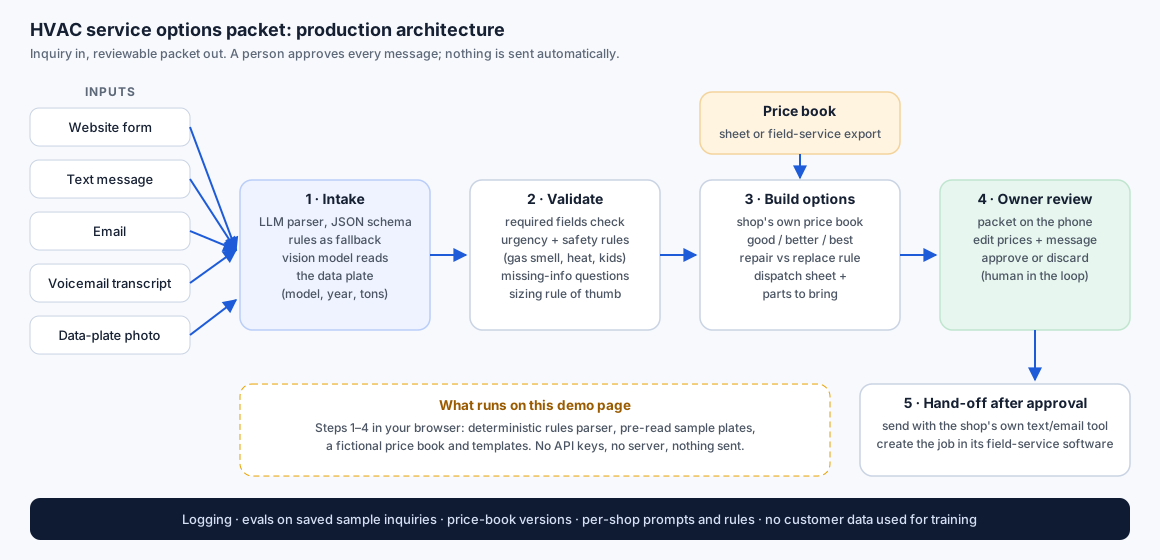
- Parse. The inquiry becomes structured JSON: contact details, city/ZIP (which picks the shop), system type, brand, age, home size, symptoms, access notes and time window. The sample data plate adds model, year, tonnage and refrigerant. This page uses a deterministic rules parser; production uses an LLM and a vision model held to the same JSON schema, with the rules kept as a fallback and as test checks.
- Triage. Rules score urgency (no cooling, extreme heat or cold, vulnerable occupants, water reaching a ceiling, gas smell) and list what's missing, so the callback asks the right questions. The likely causes are possible causes to check, not a diagnosis.
- Price. Each symptom maps to repair lines in the price book. Good fixes the most likely cause, Better adds the parts that usually fail next plus a maintenance plan, and Best sizes a replacement (tonnage from the plate, or a sq-ft rule of thumb flagged for a load calculation). A repair-vs-replace note uses age, refrigerant type and the age × repair-cost rule of thumb.
- Review. The owner sees one packet, unticks lines, edits the message and decides. Nothing is sent from this page.
Production architecture